


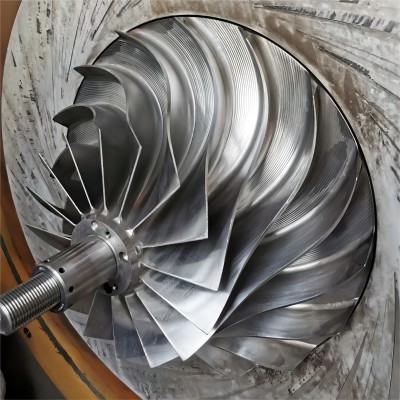
When using centrifuge impellers in industrial processes, fouling can have a significant impact on their performance. Fouling is the build-up of material in the impeller passages that results in reduced flow area and surface roughness. This paper examines the effects of fouling on the performance of centrifuge impellers, focusing on changes in gas velocity, tangential velocity, head capacity, efficiency and shock margin.

Gas Velocity and Flow Angle
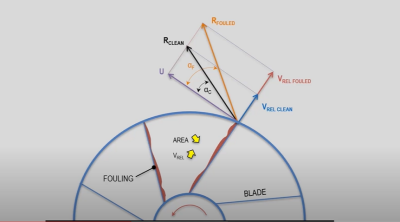
When the impeller is clean, the gas velocity determines the gas outlet velocity relative to the blade and impeller tip velocities. Under clean conditions, the gas exit velocity is the sum of these two vectors. We refer to this flow angle as α_c, where the subscript “c” stands for clean conditions. However, when the impeller is covered with dirt and the runner area is reduced, the gas exit velocity increases due to conservation of mass. This results in a different flow angle, which we denote as α_f, where the subscript “f” represents the fouling condition.
Tangential velocity and head capacity
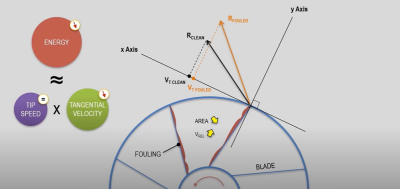
In order to understand the effect of fouling on tangential velocity, we focused on the x-component of tangential velocity. When plotting the tangential velocity curves for clean and fouled conditions, we observe that the tangential velocity is lower in fouled conditions than in clean conditions. The tangential velocity of the gas is lower when the impeller is covered with dirt.
Since the head produced by the impeller is the product of the impeller tip velocity (unaffected by fouling) and the tangential velocity, the reduction in tangential velocity results in a reduction in head capacity. In other words, under fouling conditions, the impeller is less effective in producing the required pressure head.
Efficiency and flow distribution
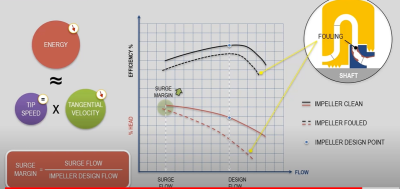
Impeller fouling not only affects head capacity, but also reduces the efficiency of the impeller stage. When impeller passages are clogged with fouling, the flow distribution becomes uneven. This uneven flow distribution hinders the impeller’s ability to efficiently convert kinetic energy into pressure energy. As a result, the overall efficiency of the impeller is reduced.
Shock Margin and Impeller Flow
Interestingly, fouling has a positive effect on shock margin. Shock is a phenomenon of low gas velocities that can lead to unstable operation. In the presence of fouling, the reduced flow area increases the gas velocity and hence the shock margin. The shock margin represents the ratio of shock flow rate to the impeller design flow rate.
However, despite the increase in shock margin, the head produced by the impeller at any flow rate is reduced by fouling. Therefore, for a given process system head requirement, the impeller flow will decrease from the design point to the fouling flow. This will result in an operating point close to the shock line, increasing the risk of shock.
Fouling has a significant effect on centrifuge impeller performance. Fouling results in reduced flow area and surface roughness, which affects gas velocity, tangential velocity, head capacity, efficiency, shock margin and impeller flow. Centrifuge impeller fouling reduces tangential velocity, resulting in reduced head capacity. Uneven flow distribution reduces impeller efficiency, while reduced impeller flow brings the operating point closer to the shock line. Understanding and cleaning fouling is critical to maintaining optimum performance and stability of centrifuge drive systems.